The history of IWC
82 watches for sale · 24 dealers · $2,495 to $265,200 · typically $8,995
Explore the rich history, technical innovations, and iconic collections of IWC Schaffhausen, a brand synonymous with precision engineering and enduring design.
IWC Schaffhausen, formally known as the International Watch Company, stands as a distinguished pillar in the world of luxury watchmaking, celebrated for its unwavering commitment to precision engineering and robust, functional design. Its unique blend of American entrepreneurial spirit and Swiss horological mastery has shaped a brand with a profound legacy.
Foundational History
IWC was established in 1868 by American watchmaker Florentine Ariosto Jones in Schaffhausen, Switzerland. Jones' vision was to merge advanced American manufacturing techniques with the esteemed craftsmanship of Swiss watchmakers, leveraging the Rhine River's hydropower for his factory operations. This strategic location in German-speaking Switzerland set IWC apart from most Swiss watch manufacturers concentrated in the French-speaking Jura region.
Pivotal moments in its early history include the construction of its dedicated headquarters in 1875 and the introduction of the first pocket watches with a digital display for hours and minutes in 1885. The company saw a change in ownership in 1880, transferring to the Rauschenbach family. A significant step in wristwatch development came in 1899 with the release of IWC's first wristwatch, designed for ladies. In 2000, IWC became a subsidiary of the Swiss Richemont Group, continuing its journey under a larger luxury conglomerate.
Horological Significance
IWC's reputation as the "Engineer of Watchmaking" is underpinned by several groundbreaking technical innovations. One of its most notable contributions is the Pellaton Winding System, invented by Technical Director Albert Pellaton in the late 1940s and patented in 1946. This highly efficient, bidirectional pawl-winding system converts the rotor's movements into a unidirectional winding motion, known for its exceptional efficiency, robustness, shock resistance, and reduced wear, often incorporating ceramic pawls in modern iterations. It powers many of IWC's high-performance in-house movements, including the Calibre 85 and 52000 families.
Another significant innovation is the Perpetual Calendar developed by Kurt Klaus in the mid-1980s, famously debuted in the Da Vinci collection. This mechanical perpetual calendar is celebrated for its user-friendliness, allowing all indications to be adjusted simply via the crown, and requiring virtually no correction until 2499.
IWC has also been a pioneer in material innovation. In 1980, it introduced the world's first watch case made from titanium with the IWC Porsche Design Titan Chronograph. The brand further demonstrated its material expertise in 1986 with the Da Vinci Perpetual Calendar, featuring one of the first scratch-resistant ceramic cases made from black zirconium oxide. This pioneering spirit continues with developments like Ceratanium® and Ceralume®, a fully luminescent ceramic.
Three Defining Collections/Models
Portugieser
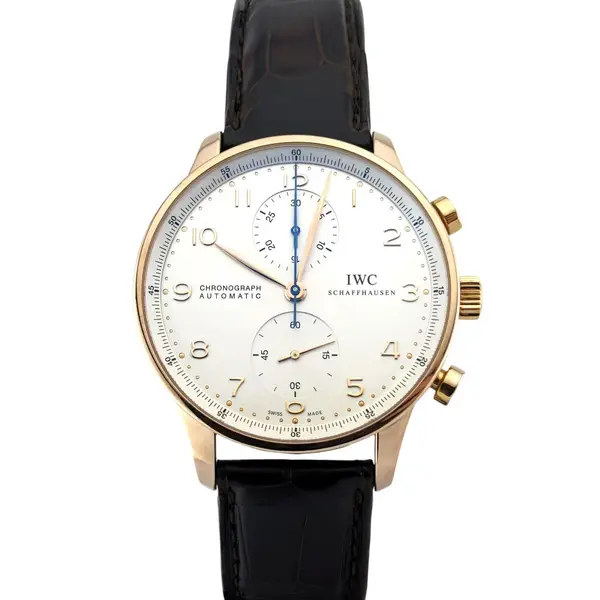
Launched in 1939, the Portugieser collection originated from a request by two Portuguese businessmen for a wristwatch with the precision of a marine chronometer. This led to the creation of a remarkably large wristwatch for its era, housing a highly accurate pocket watch movement. Its distinctive design, characterised by a clean, minimalist dial with Arabic numerals, slender feuille hands, and a railway track chapter ring, has made it an enduring icon. The Portugieser remains a cornerstone of IWC's offerings, highly sought after by collectors and buyers for its classic elegance and horological significance.
Pilot's Watches
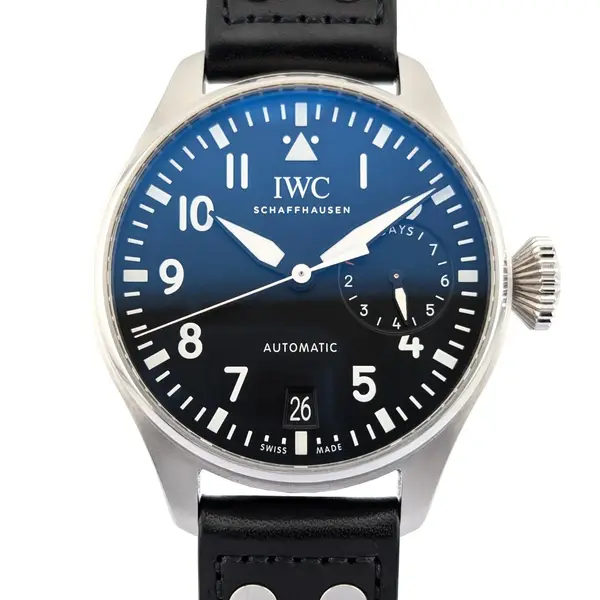
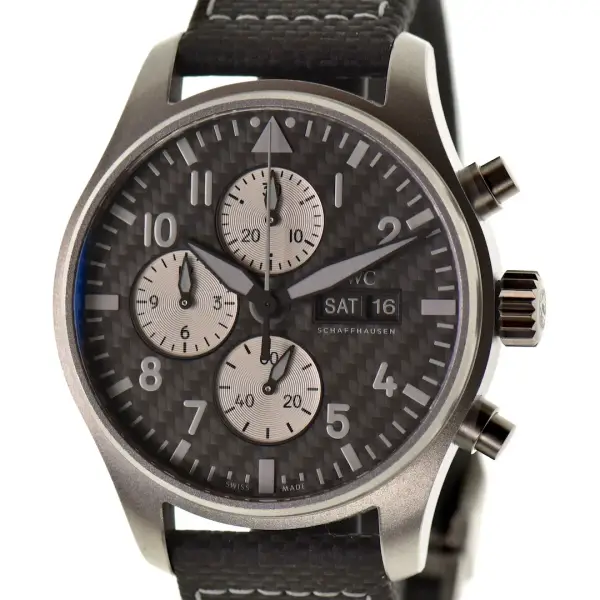
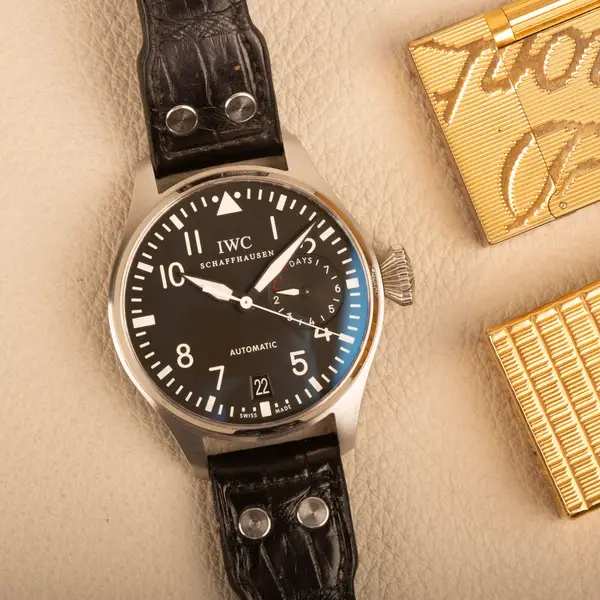
IWC's Pilot's Watches collection traces its origins to 1936 with the introduction of the "Special Pilot's Watch". Developed for the rigorous demands of aviation, these watches are renowned for their exceptional legibility, robust construction, and anti-magnetic properties. The Mark XI, introduced in 1948 for the British Royal Air Force, is particularly iconic, featuring a soft-iron inner case to protect the movement from magnetic fields. The Big Pilot's Watch, first appearing in 1940, is another emblematic model, known for its oversized case and clear, instrument-like dial. These watches are celebrated for their authentic aviation heritage and functional design.
Da Vinci
The Da Vinci collection debuted in 1969, initially making a significant impact by housing the Beta 21 quartz movement, the first Swiss-made quartz calibre, within a distinctive hexagonal gold case. However, it truly cemented its place in horological history in 1985 with the introduction of Kurt Klaus's legendary perpetual calendar. The collection also pioneered the use of ceramic cases in wristwatches. The Da Vinci symbolises IWC's inventive spirit, combining complex mechanical solutions with a refined aesthetic.
Current Market Positioning
IWC Schaffhausen is firmly positioned within the luxury watch segment, recognised globally among top luxury brands. It is not considered an entry-level luxury brand but rather a respected manufacturer known for its technical mastery and engineering-focused approach, often referred to as the "Engineer of Watchmaking".
In the Australian market, IWC watches typically range from approximately AUD 8,500 for entry-level three-hand models like the Portofino Automatic or Pilot's Watch Mark XX. Chronograph models, such as those in the Pilot's Watch collection, generally fall between AUD 13,800 and AUD 19,000. More complicated pieces, including perpetual calendars from collections like the Portugieser, can command prices upwards of AUD 87,500.
Compared to its peers, IWC sits alongside esteemed brands such as Omega, Breitling, and Panerai. While it may not consistently achieve the same secondary market value retention as the "Big Three" (Rolex, Patek Philippe, Audemars Piguet), IWC is highly regarded for its in-house movements, material innovations, and distinct design language, appealing to collectors who value technical substance and a rich heritage. The brand's commitment to sustainability also sets it apart in the industry.
Sources and references 32
- watchadvice.com.au
- zealande.com
- en.wikipedia.org
- watchinsanity.it
- dalucastraps.com
- watchswiss.com
- kapoorwatch.com
- iwc.com
- iwc.com
- chronoseconds.com
- iwc.com
- chrono24.com
- watchdossier.ch
- en.worldtempus.com
- iwc.com
- teddybaldassarre.com
- beverlyloan.com
- watchbiz.com.au
- iwc.com
- paulsheeran.ie
- revolutionwatch.com
- timepiece360.com
- monochrome-watches.com
- monochrome-watches.com
- watchprozine.com
- deployant.com
- bobswatches.com
- luxurybazaar.com
- chronext.com
- mygemma.com
- gregoryjewellers.com.au
- exquisitetimepieces.com

Just listed
- IWC Vintage Ingenieur Automatic IW323301 · 43mm
- IWC Ingenieur Automatic 40 IW328907 · 40mm
- IWC Pilot's Watch Spitfire Mark XVI IW325505 · 38.1mm
Hunting a specific IWC reference? Ask us to find it
Questions?
We read every message.
About Watch Scout
We're not a dealer - you buy direct from the dealer. One search covers every Australian dealer we track.