The history of Audemars Piguet
60 watches for sale · 25 dealers · $3,400 to $195,000 · typically $45,400
Explore the rich history, technical mastery, iconic collections, and exclusive market position of Audemars Piguet, a titan of Swiss haute horlogerie.
Audemars Piguet, a name synonymous with haute horlogerie, has carved an indelible mark on the landscape of luxury watchmaking since its inception. Founded in 1875 by Jules Louis Audemars and Edward Auguste Piguet in the serene Vallée de Joux, Switzerland, the brand has remained steadfastly family-owned, a rarity in today's industry. From its earliest days, Audemars Piguet specialised in crafting complicated watch movements, laying the groundwork for a legacy of technical mastery.
Horological Significance
What truly sets Audemars Piguet apart is its unwavering commitment to horological innovation and intricate craftsmanship. The brand has consistently pushed boundaries, achieving numerous 'world firsts'. In 1892, they created the first minute-repeating wristwatch movement, a significant technical feat. This was followed by the introduction of the first skeleton watch in 1934, showcasing the intricate mechanics within, and the production of the thinnest wristwatch in 1946. Audemars Piguet is renowned for its ultra-thin calibres, such as the Calibre 2120, which was the world's thinnest self-winding movement of its era. More recently, the brand developed a direct-impulse escapement in 2006, inspired by 18th-century clockmaker Robert Robin, and a double balance wheel escapement in 2016 to enhance precision and stability. Their 2015 Supersonnerie mechanism also revolutionised minute repeater technology, demonstrating a continuous pursuit of excellence in complex complications.
Defining Collections
Three collections stand as pillars of Audemars Piguet's enduring appeal to collectors and buyers:
The Royal Oak
Introduced in 1972, the Royal Oak is arguably Audemars Piguet's most iconic creation and a pivotal moment in watchmaking history. Designed by the legendary Gérald Genta, it was the world's first luxury sports watch crafted from stainless steel. Its distinctive octagonal bezel with exposed hexagonal screws, integrated bracelet, and 'Tapisserie' dial challenged conventional notions of luxury, proving that high horology could exist beyond precious metals. The Royal Oak not only saved the brand during the quartz crisis but also established an entirely new category of watches, making it highly coveted for its groundbreaking design and historical significance.
The Royal Oak Offshore
Launched in 1993, the Royal Oak Offshore took the original's bold aesthetic and amplified it. This larger, more robust, and overtly sporty iteration, affectionately nicknamed 'The Beast', further expanded the Royal Oak's appeal. It pioneered the use of materials like rubber on crowns and pushers and embraced a more muscular design. The Offshore cemented Audemars Piguet's position in the luxury sports watch segment and became a canvas for innovative materials and celebrity collaborations, attracting a younger, dynamic audience.
Code 11.59 by Audemars Piguet
The Code 11.59, introduced in 2019, represents Audemars Piguet's contemporary vision for traditional watchmaking. While retaining a classic round dial, its complex case construction features an octagonal middle case, a nod to the Royal Oak, nestled within a round bezel and caseback. This collection showcases the brand's technical prowess through sophisticated movements and complications, offering a modern and architectural interpretation of luxury timepieces. It signifies Audemars Piguet's ongoing commitment to innovation and design evolution.
Current Market Positioning
Audemars Piguet firmly occupies the pinnacle of high horology, often cited as one of the "Holy Trinity" of watchmaking alongside Patek Philippe and Vacheron Constantin. The brand maintains a highly exclusive market position, producing a limited number of watches annually (estimated around 50,000 units). This scarcity, coupled with exceptional craftsmanship and iconic designs, drives strong demand and value retention, often seeing models trade above retail prices on the secondary market.
In the Australian market, Audemars Piguet watches sit at the upper echelons of luxury. Entry-level Royal Oak models in steel typically start from approximately AUD$37,500 to AUD$45,000 at retail, though secondary market prices can easily reach AUD$60,000 to AUD$90,000 or more due to demand and waiting lists. Mid-range complications can command prices between AUD$75,000 and AUD$225,000, while high-complication or limited-edition pieces frequently exceed AUD$150,000, often soaring past AUD$1,500,000. Compared to peers like Rolex, Audemars Piguet generally starts at a higher price point, focusing on advanced complications and intricate finishing, and is often considered to offer greater horological complexity and hand-finishing. Its Royal Oak models, in particular, frequently command higher premiums than comparable Rolex sports models in the secondary market.
Sources and references 30
- en.wikipedia.org
- apchronicles.audemarspiguet.com
- swisswatchexpo.com
- audemarspiguet.com
- chronext.com
- en.worldtempus.com
- audemarspiguet.com
- watchcentre.com
- the1916company.com
- sothebys.com
- chronohunter.com
- fratellowatches.com
- bobswatches.com
- audemarspiguet.com
- audemarspiguet.com
- timepiecetradingllc.com
- gandgtimepieces.com
- bobswatches.com
- wristaficionado.com
- swisswatches-magazine.com
- aviandco.com
- monochrome-watches.com
- aviandco.com
- luxurybazaar.com
- gandgtimepieces.com
- bobswatches.com
- luxurysociety.com
- swissiceco.com
- phigora.com
- 959deluxe.com
Audemars Piguet for sale
Every Audemars Piguet we track at Australia's independent dealers.
 Audemars Piguet Royal Oak 24 for sale from $17,990
 Audemars Piguet Royal Oak Offshore Chronograph 6 for sale from $24,999
 Audemars Piguet Royal Oak Offshore 3 for sale from $28,995
 Audemars Piguet Royal Oak Chronograph 2 for sale
 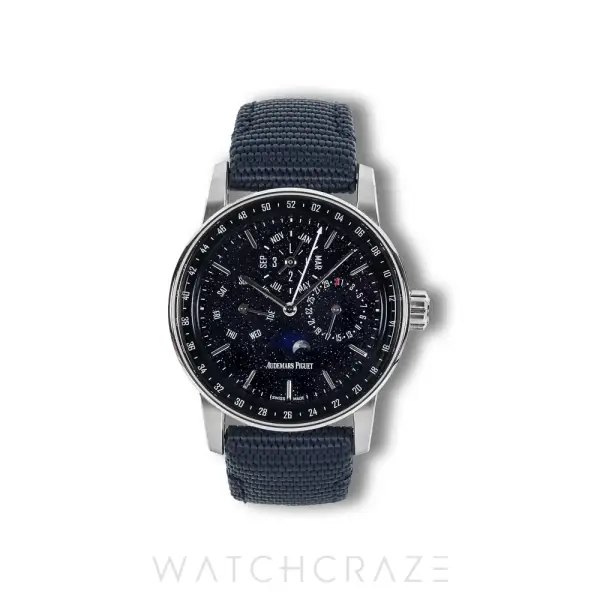 Audemars Piguet Code 11.59 2 for sale from $31,500
 Audemars Piguet N/A 2 for sale
Just listed
- Audemars Piguet Royal Oak Offshore Chronograph 26170ST.OO.1000ST.01 · 42mm
- Audemars Piguet Royal Oak Offshore Ghost 26470IO.OO.A006CA.01 · 42mm
- Audemars Piguet Royal Oak Dual Time 25730ST · 36mm
Hunting a specific Audemars Piguet reference? Ask us to find it
Questions?
We read every message.
About Watch Scout
We're not a dealer - you buy direct from the dealer. One search covers every Australian dealer we track.